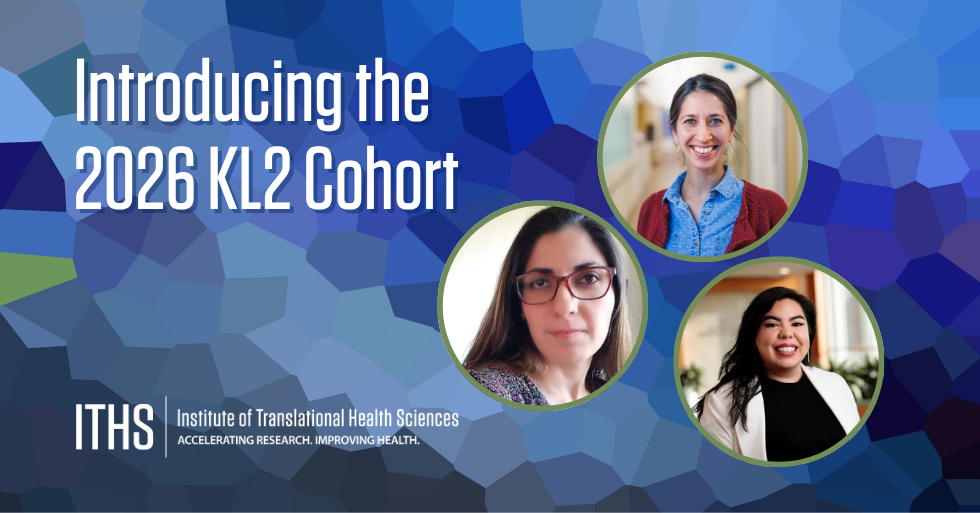
26 Mar Welcome to the 2026 Cohort of ITHS KL2 Scholars
The Institute of Translational Health Sciences proudly announces the 2026 cohort of the ITHS KL2 Multidisciplinary Clinical Research Career Development Program for post-doctoral scholars. ITHS will provide protected research time, funding, mentorship, and other necessary resources to foster the development of their clinical and translational research skills. This new cohort of early career investigators includes Minerva Orellana, Mariam Hantouli, Shadi Esmaeili-Wellman, and Sheela Damle, all of whom started in the program on March 1st and will stay with ITHS through February 2029.
In addition to receiving training tailored to their particular research and career development needs, the four new KL2s will gain knowledge of the full spectrum of health sciences research in the NIH-sponsored program through this program. They will attend interactive seminars along with the 2022 and 2023 cohorts, getting training in the core competencies for translational research developed by the Clinical and Translational Science Award (CTSA) institutes. Scholars will also have the opportunity to enhance their presentation and writing skills.
We recently spoke to KL2 Program Distinguished Faculty Dr. Mandy Fretts about her time as a KL2 scholar.
The KL2 is a very special program, and I think a highlight is the opportunity to work with faculty across the spectrum of translational sciences.
“The opportunity to share your research ideas with others who have different backgrounds and perspectives makes your science stronger,” said Dr. Fretts. We look forward to seeing what great ideas come from our latest group of promising scholars!
The 2026 Cohort
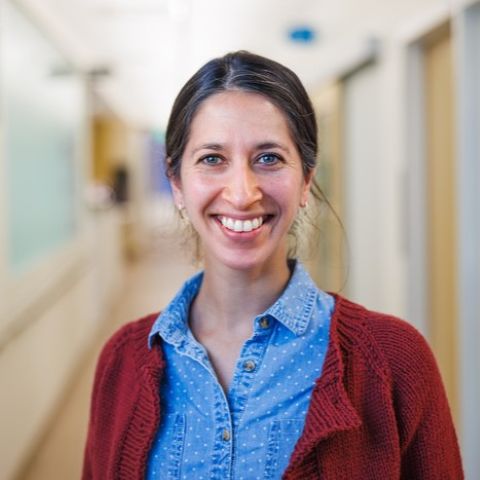 Sheela Damle, MD, PhD, is an Assistant Professor in the gastrointestinal medical oncology group at Fred Hutch Cancer Center. Dr. Damle earned her MD PhD from Virginia Commonwealth University where she developed a deep interest in immunology and completed her internal medicine residency training at University of Washington. She stayed at University of Washington/Fred Hutch Cancer Center for her hematology and oncology fellowship, where she worked with Dr. Venu Pillarisetty studying intratumoral clusters of dendritic cells and T cells in human pancreatic cancer and developing immunomodulating therapies. Her research focus on translational approaches to understand and target myeloid cells in gastrointestinal malignancies. Her clinical focus is colorectal cancer and pancreatic cancer.
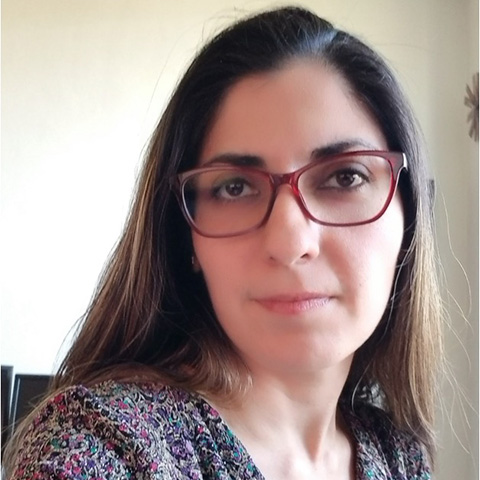 Shadi Esmaeili-Wellman, MEd, PhD, is a physicist by training with experience in multidisciplinary research. Her work focuses on understanding and modeling complex, multidimensional systems using mathematics, statistical physics, and nonlinear dynamics. As a staff scientist at Dr. Joshua Schiffer’s group, she developed a pipeline for clinical trial simulation combining the data-driven within-host viral dynamics model of SARS-COV-2 with the pharmacokinetics and pharmacodynamics of different antiviral drugs developed against the virus to explore treatment regimens, inform the design of future clinical trials and answer drug-specific questions which are beyond the scope of clinical trials.
Mariam Hantouli, MD, is a Research Assistant Professor in the Department of Surgery at the University of Washington and a core collaborator with the Surgical Outcomes Research Center. As a physician-researcher, she focuses on addressing critical evidence gaps for patients with gastrointestinal diseases, including appendicitis, diverticulitis, and gallbladder diseases, with an emphasis on centering populations who are underrepresented in clinical research. Drawing on her expertise in comparative effectiveness research, claims data analysis, and implementation science, her proposed research will generate trimester-specific outcomes data for appendicitis and cholecystitis during pregnancy and develop a decision aid that translates complex evidence into practical, patient-centered guidance. Dr. Hantouli brings lived experience and personal understanding to her commitment to improving evidence-based care for patients. Her long-term goal is to become an independently funded translational researcher who develops, evaluates, and implements interventions that improve access, outcomes, and patient experiences. Beyond her research contributions, Dr. Hantouli is dedicated to mentoring and educating the next generation of surgical health services researchers.
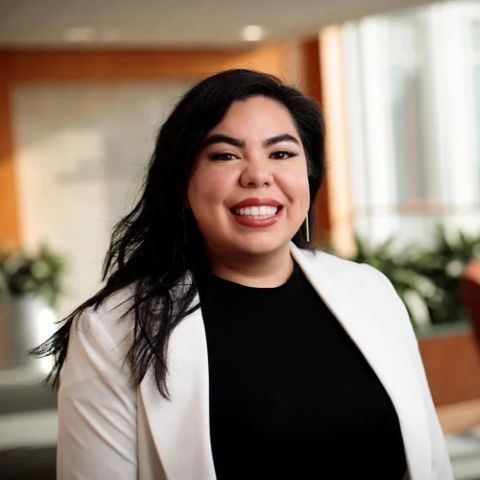 Minerva Orellana, PhD, MS, is a first-generation college student and the daughter of Salvadoran immigrants. She has a BS in Physiology and MS in Cell & Molecular Biology from San Francisco State University. She received her PhD from the Mayo Clinic Graduate School of Biomedical Science in Clinical and Translational Science. Dr. Orellana’s research has focused on gynecologic health equity, spanning from maternal care, infertility, uterine fibroids, and endometrial cancer. She’s currently an Acting Assistant Professor in the Department of Obstetrics and Gynecology at the University of Washington. Her research focus will be on Latina gynecologic health.
The KL2 program is funded by the National Institutes of Health through ITHS’ grant with the National Center for Advancing Translational Sciences. Part of the KL2 program mission is to provide an entryway for early investigators to the field of Translational Science. Visit the ITHS Education pages to learn more about the KL2 program and other education offerings from ITHS.